The company Swietelsky-Faber has doubled its workforce in recent years solely and exclusively through organic growth. Today, with well over 350 colleagues and annual revenue of 85 million euros, it is one of the large companies in trenchless infrastructure maintenance. Despite the rapid growth, we have usually succeeded very well in maintaining service at eye level with the customer, like a family business. But not only this Swietelsky-Faber DNA is a key factor. There are still some noteworthy details...
Investor groups are intervening in the market
The trend, increasingly spreading today, of company acquisitions by foreign investor groups for integrating companies into a new large corporate structure has nothing in common with organic growth and loyal employees.
On closer inspection, it becomes clear that these investors are quickly aiming for the highest possible return on investment. Either the newly assembled companies generate particularly high profits very quickly, or the overall corporate structure must be resold to the next investors very soon. This situation may possibly increase the market value of some executives, but certainly not the loyalty and quality of the other employees.
Look to one's own nose
Protagonists in the construction industry warn of the consequences of an ageing society and the associated shortage of skilled workers and managers in growth markets.
In order to be able to provide not only the device technology, but above all the human resources for this market growth, a company is also in competition with other companies for employees outside its familiar industry. This is particularly evident in industrial centers. Recruitment agencies like to exploit this market situation, often with questionable success.
A Topic for the Industry Associations
Regarding overarching measures surrounding the issue of skilled labour shortage, the associations and organisations of the industry are increasingly required. There is still considerable room for improvement here. With a view to the future, the Pipeline Construction Association has developed the necessary awareness of the problem and, through its vocational training centre, does really good work with a focus on traditional pipeline construction. Another positive example is provided by the VDRK, which has established a defined occupational profile and a recognised training occupation for the industry with the Technician for Pipe, Sewer and Industrial Service.
In the associations in which the interests of pipe rehabilitation and trenchless construction methods are to be combined, such as the pipe rehabilitation association or GSTT, the topic has not yet arrived to the necessary extent, especially with regard to commercial employees.
Therefore, Swietelsky-Faber supports initiatives and actions in the industry associations with the aim of arousing young people's interest in and enthusiasm for the industry.
What makes companies attractive to young talent?
Of course, a company must ultimately also face the challenges of the shortage of skilled workers itself. In the competition for young people, an employer must convincingly and clearly demonstrate that it can offer attractive jobs with a secure future perspective. More and more often, we also find that our principles on sustainability and energy efficiency are being questioned in employee discussions. Mere greenwashing will not get you through in the long run.
Furthermore, in Swietelsky-Faber's view, alongside the training of young talent, a company must also pay close attention to the quality, loyalty, and commitment of experienced employees. This valuable experience of long-serving employees and managers is of immense importance for the development, motivation, and protection of junior staff, which is underestimated in some companies.
The so-called coaching of young professionals thus secures our future. Swietelsky-Faber therefore places special emphasis on demanding training for our young professionals. Up to 14 trainees, equally divided between the skilled trades and commercial areas, complete their training at the company each year with experienced coaches at their side.
Communicating attractiveness
To present itself as an attractive company and become visible to young people, Swietelsky-Faber takes part in various regional training fairs, among other things, and is present on social networks. Many young people are not even aware of how attractive training to become a skilled worker in pipe, sewer and industrial services actually is. The variety of the work, the opportunities for advancement, and the handling and operation of state-of-the-art and sophisticated technology: all of these are factors that our youth often are not aware of.
In addition, the flawless technical equipment of the construction machinery is also a basic prerequisite for employee motivation in terms of the attractiveness of the workplace. In addition, there are constantly revised digitalization processes and internal employee communication on an equal footing.
Swietelsky-Faber invests up to 10 percent of its annual turnover in the modernization of technical equipment and in new equipment. This is not only an investment in equipment technology, but also in good working conditions and an investment in employee satisfaction.
Because, in particular, employee satisfaction is a decisive factor for the willingness to provide service and the loyalty of employees, as well as for the positive external image of a company.
Fair wages and salaries
In the services of sewer rehabilitation, there is no dispute that these are construction services. Compliance with the applicable construction tariff conditions is a minimum requirement for good execution quality and for fair competitive conditions. Unfortunately, however, we are increasingly noticing violations of tariff compliance in our day-to-day business. From incorrect tariff compliance declarations by subcontractors to procurement violations involving companies that ignore the construction tariff or are not even affiliated with Soka-Bau. Some readers may now be inclined to say that this simply cannot happen - but in fact it happens more often than some planners and clients think.
Every builder should be aware of this already during the planning stage and, please, should check the tariff compliance of the possible contracting partners before awarding contracts.
There are enough tools for this, but we should also use them consistently in the interest of fair compensation for our commercial employees. Even if this may mean excluding a minimum bidder from the evaluation. Unfortunately, the issue of consistently complying with construction sector tariff compliance is hardly met with approval in our association landscape and in the seminars.
Apparently, no one in the seminars is interested in fair remuneration for commercial employees. Instead, people discuss poor quality of execution. Slightly exaggerating, one could therefore say: “Here, the cause is not being discussed, but rather the effect of a matter".”
Arguing with confidence
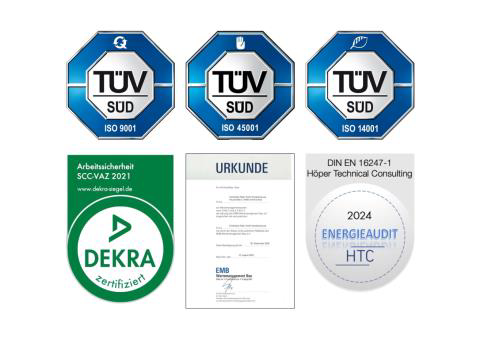
In the context of recruiting employees, occupational safety also takes a leading place. It begins with personal protective equipment, on which no money is saved, and continues with extensive internal training and occupational safety management systems such as the highly demanding Safety Certificate for Contractors (SCC**) required by clients from the petrochemical industry.
This system significantly increases efficiency in the area of occupational safety and has the long-term effect of significantly reducing the quotient of lost working time, the so-called Lost Time Injury Rate (LTIR).
The LTIR thus describes a key factor which, to this day, unfortunately is hardly used to assess the service capability of companies.
Measures for occupational safety are in part complex; they require time and initially cost money. However, these efforts are also noticed by employees and, with honest communication, can be perceived as appreciation of staff. It is therefore a false economy not to establish such systems in one's own company. It would even be desirable if our clients would require such occupational safety management systems from their bidders as evidence of their service capability. Because every workplace accident is one workplace accident too many.
Good Prospects
The attractiveness of an industry and a company is significantly influenced by its future prospects. Due alone to the enormous need for action to repair our underground infrastructure, sewer rehabilitation will continue to develop and offer the people working in this industry good career prospects.
We are in a growth market, and this trend is unlikely to slow down in the coming years. Against this backdrop alone, it is a good choice for young people to choose a path into this professional environment.
At Swietelsky-Faber, transparency and openness of the hierarchical structures within the company are important factors. It is not only the hierarchical level that is decisive for decision-making processes, but the better argument - regardless of where it comes from.
This basic setting enables young and committed employees to contribute to leadership processes in accordance with their potential and inclinations and to develop further in the process.
In addition, employees are offered extensive qualification measures such as extending a driver's license or training to become a certified remediation consultant. These are investments that, in our experience, pay off in many ways. They improve both the service capability of the company as well as employee retention and acceptance by customers. Also related to training and qualification is cooperation with universities and support for female and male students with topics for their bachelor's and master's theses.
The issue of staff development is a very complex topic with many facets. If we want to find solutions, then we should all pull together on this matter. Because in fact, the situation is relatively easy to handle. Good and authentic employees like working for good and authentic companies.
Networking. Many young people are not even aware of how attractive training to become a specialist in pipe, sewer, and industrial service actually is. The variety of the work, the career prospects, and the handling and operation of state-of-the-art and sophisticated technology — all of these are factors that our young people are often not aware of.
In addition, the flawless technical equipment of the construction machinery is also a basic prerequisite for employee motivation in terms of the attractiveness of the workplace. This is complemented by continuously revised digitalization processes and internal employee communication on an equal footing.
Because, in particular, employee satisfaction is a decisive factor for the service readiness and loyalty of employees as well as for the positive external impact of a company.
The key to business success in trenchless infrastructure construction lies in the experience and commitment of the team.