Blomberg / Hamburg / Hamburg Head Office
Pipe inspection & testing technology
Author: Myriam Johnke, project manager at Swietelsky-Faber GmbH
On Erlenstraße in Bremen, an approximately 620 m long combined sewer with egg profile DN 1070/1605 was rehabilitated trenchlessly using UV liner in accordance with DIN EN ISO 11300-2. In addition to renewing the main sewer, the measure also included the renovation of 120 service connections as well as extensive manhole rehabilitation. Because transfer manholes were not present on site, separate access pits had to be constructed for each service connection. A complex flow diversion arrangement with an elevated bypass pipe ensured continuous wastewater drainage during the construction work, despite heavily frequented traffic arteries and tram traffic.
Trenchless pipe rehabilitation in Erlenstrasse
A comprehensive pipe rehabilitation measure was carried out in Erlenstrasse in Bremen on the existing combined sewer as well as on the associated connection pipes and manhole structures. The primary aim of the project was the sustainable structural upgrade of the existing infrastructure with interventions in the street space that were as minimally invasive as possible.
The work was carried out by the Hamburg branch of Swietelsky-Faber in two construction phases and combined several trenchless rehabilitation methods with targeted interventions.
Special boundary conditions in the rehabilitation area
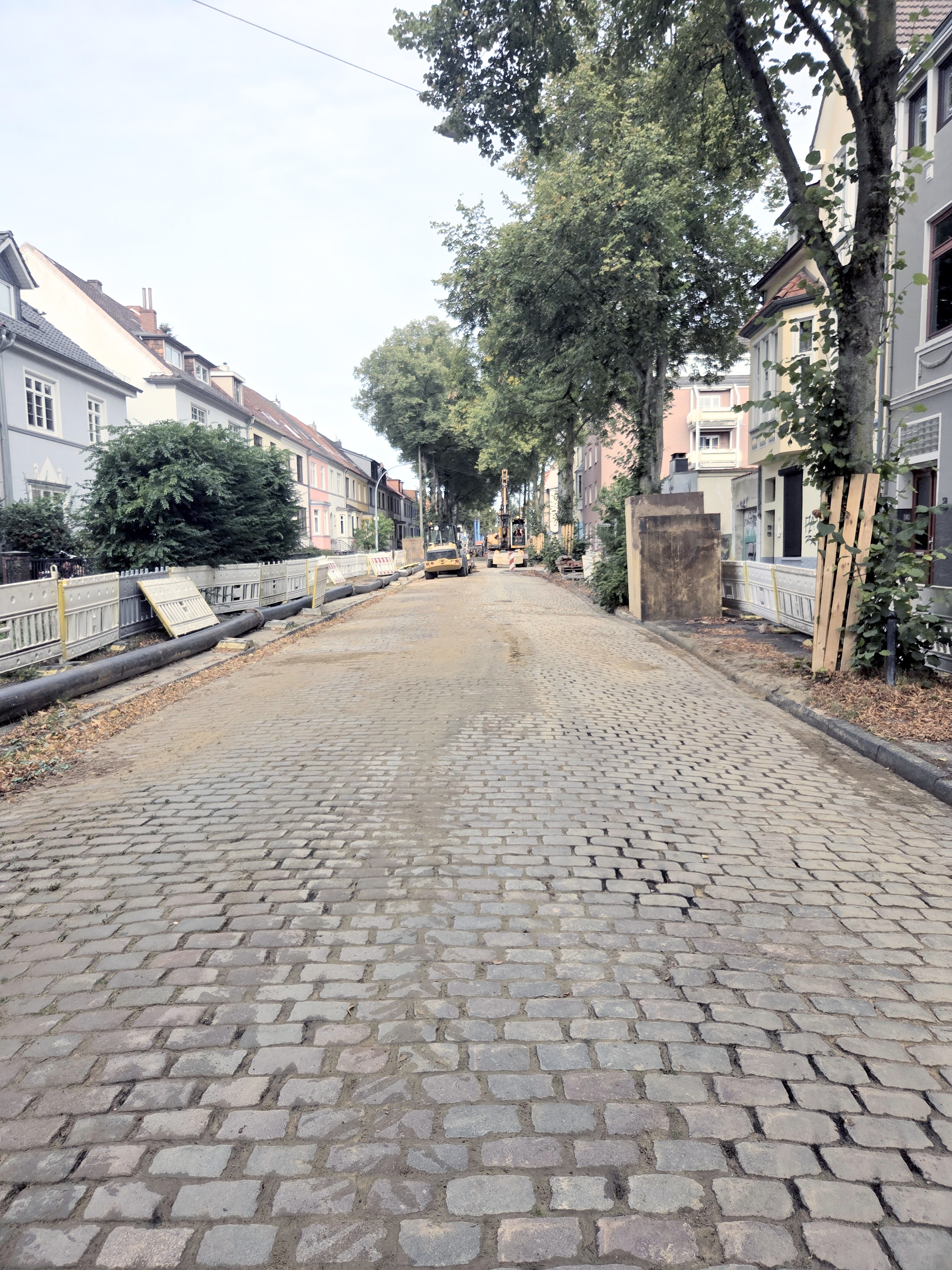
Erlenstraße in Bremen’s Neustadt district has alternating paved and asphalt surfaces in the rehabilitation area. In the inner-city location, this results in additional requirements for the construction sequence and traffic management, as an open-cut construction method would have required extensive removal and restoration work on the paved surfaces. By using trenchless methods, the existing road surface could largely be preserved, and only partial adjustments to the paved surfaces were necessary at the required excavation pits for liner insertion and manhole access.
Rehabilitation of the main sewer using a UV liner
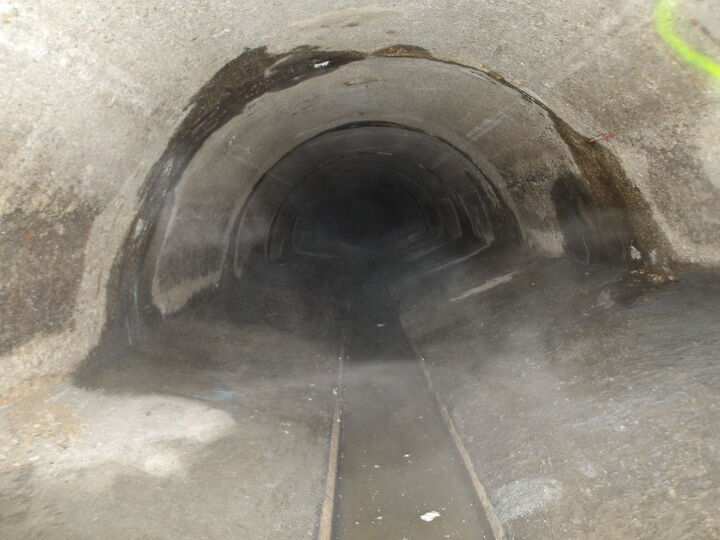
The core of the measure was the rehabilitation of an approximately 620 m long combined sewer in egg profile DN 1070/1605. Due to the structural condition of the existing pipeline, the choice fell on trenchless rehabilitation using a GRP UV liner from IMPREG.
The procedure comprised the following work steps:
- Cleaning and preparation of the existing sewer
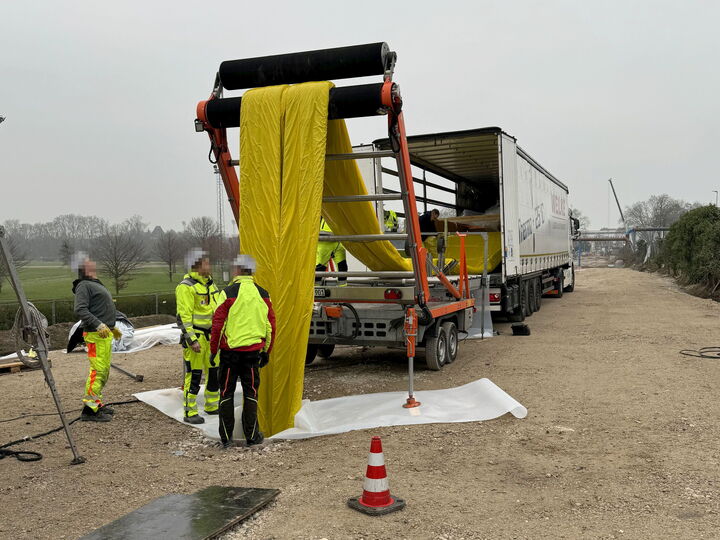
- Insertion of the glass-fibre-reinforced liner
- Curing by means of UV light
- final TV inspection
- Opening of the connections
- Connection linking
- Quality control by external experts
By installing the liner, the static load-bearing capacity of the sewer could be restored and the service life of the pipeline significantly extended.
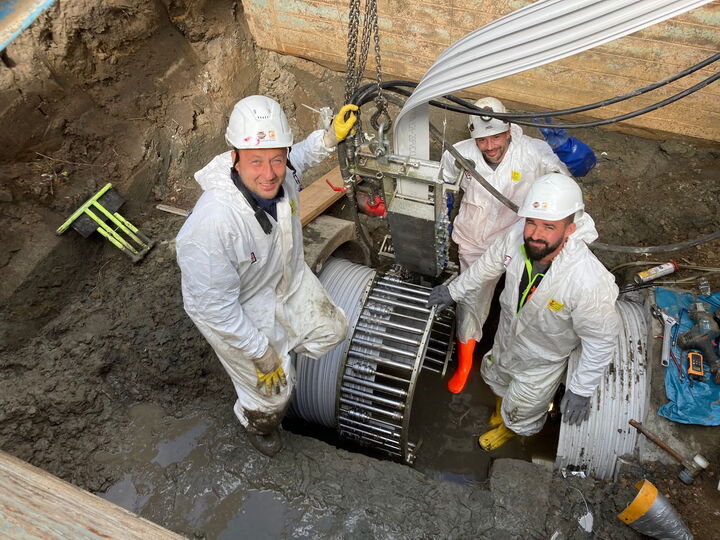
Several large-dimensioned insertion pits were constructed for the installation of the liner. Their planning and arrangement were carried out taking into account the existing utility infrastructure, the soil conditions, as well as the requirements for occupational safety and construction site logistics.
Rehabilitation of 120 service connections
In addition to the main sewer, a total of 120 service connections for sewage and stormwater were rehabilitated.
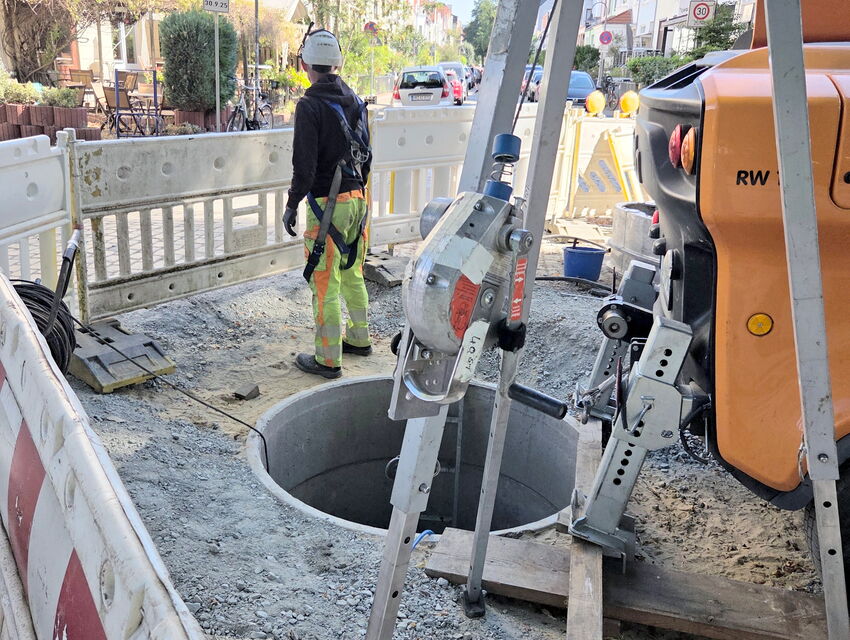
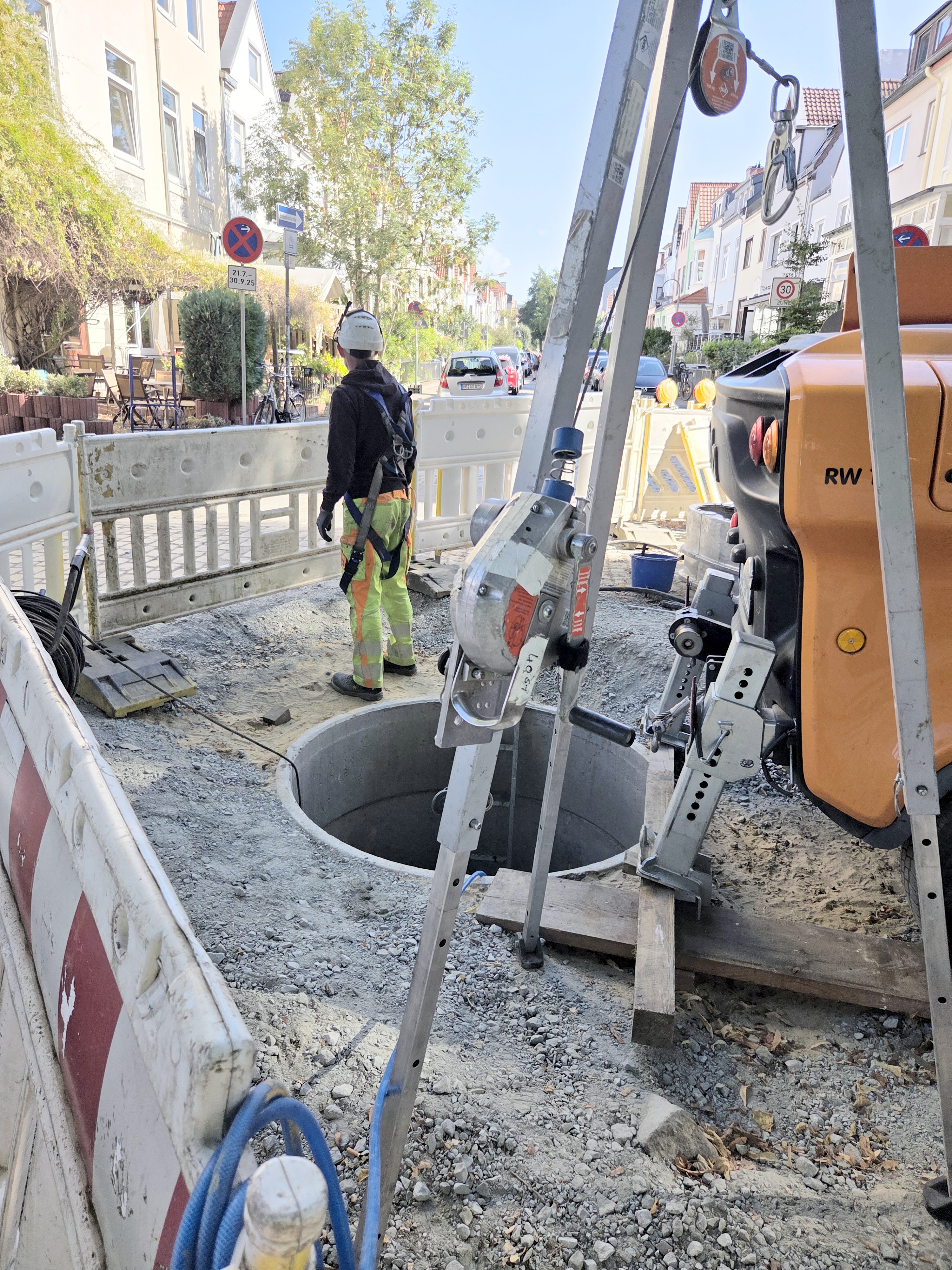
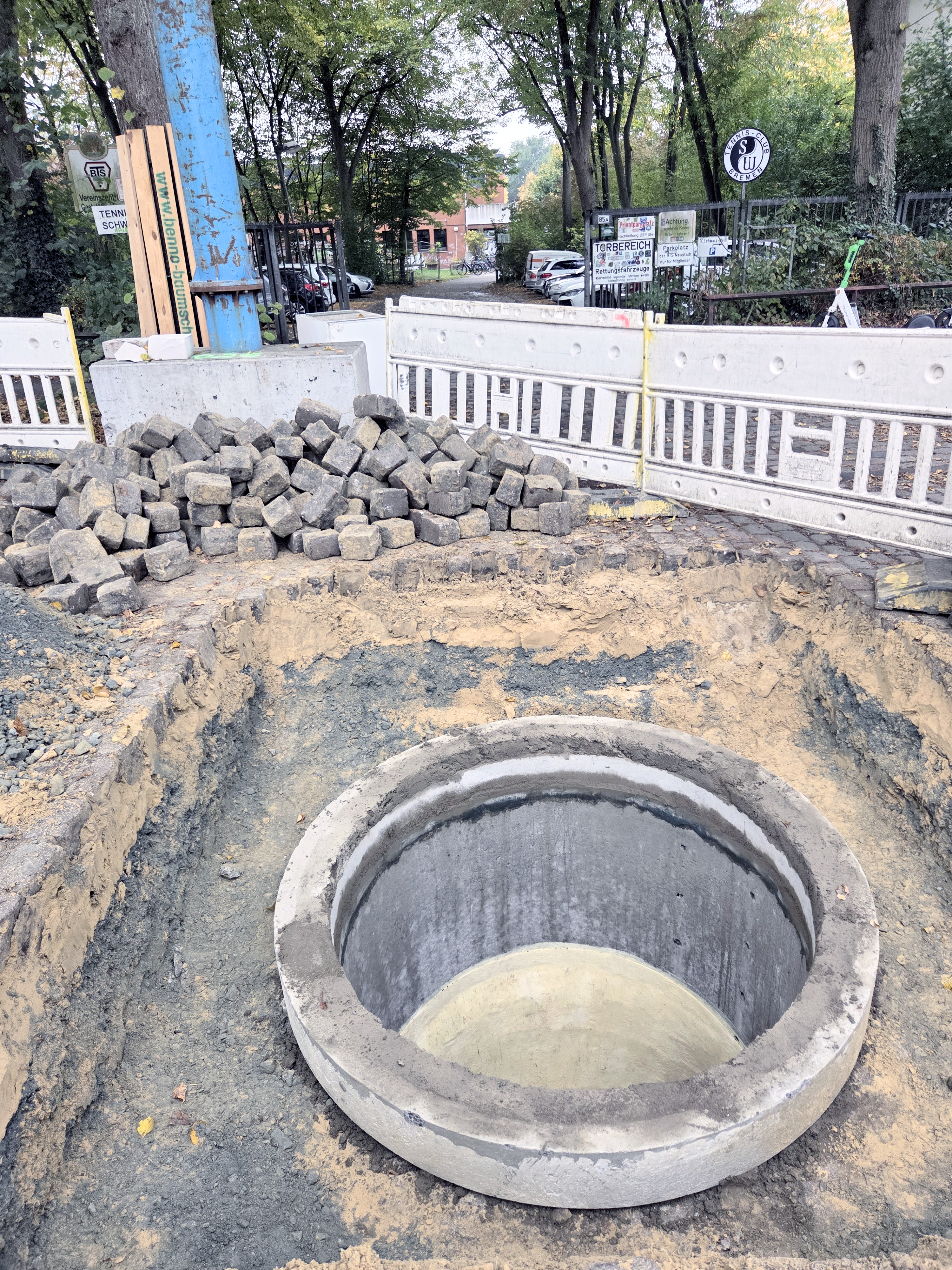
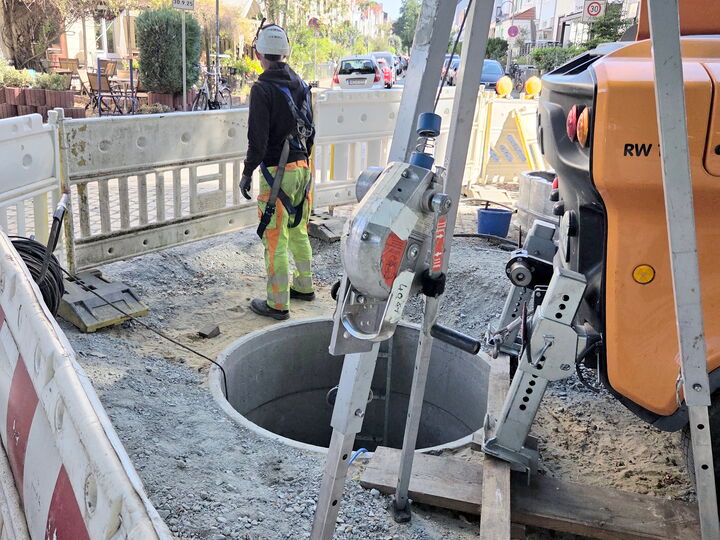
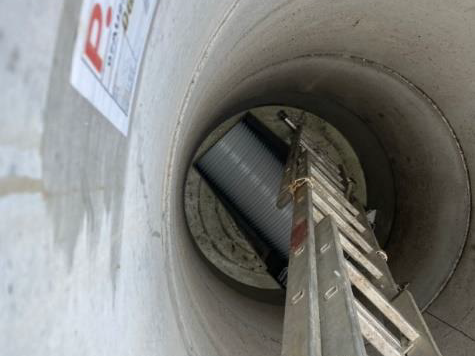
Since there were only a few access shafts in the project area, a separate launch pit had to be created for each house connection. From these pits, house connection liners were installed in two directions:
- towards the building
- towards the main sewer
This procedure made it possible to fully rehabilitate the connection lines without having to carry out additional civil engineering measures along the entire lengths of the lines.
Renovation and new construction of shaft structures
As part of the measure, several shaft structures were repaired:
- 11 shafts completely rehabilitated
- 1 manhole cover renewed
- 1 shaft newly constructed
The rehabilitation of the existing wastewater shafts was carried out in a multi-stage process. First, the structures were sealed using an injection process in order to permanently prevent leaks and pressurized water. This was followed by a mineral interior coating, which serves to even out the surface and provide structural stabilization while also creating a suitable bonding base for further coatings.
The final layer was a multi-layer GRP hand lay-up coating. This ensures long-term corrosion protection, high chemical resistance, and a smooth and hydraulically favourable surface.
Ensuring drainage during the construction work
Throughout the entire construction period, the continuous discharge of wastewater had to remain assured. For this purpose, temporary drainage protection was installed using a bypass line.
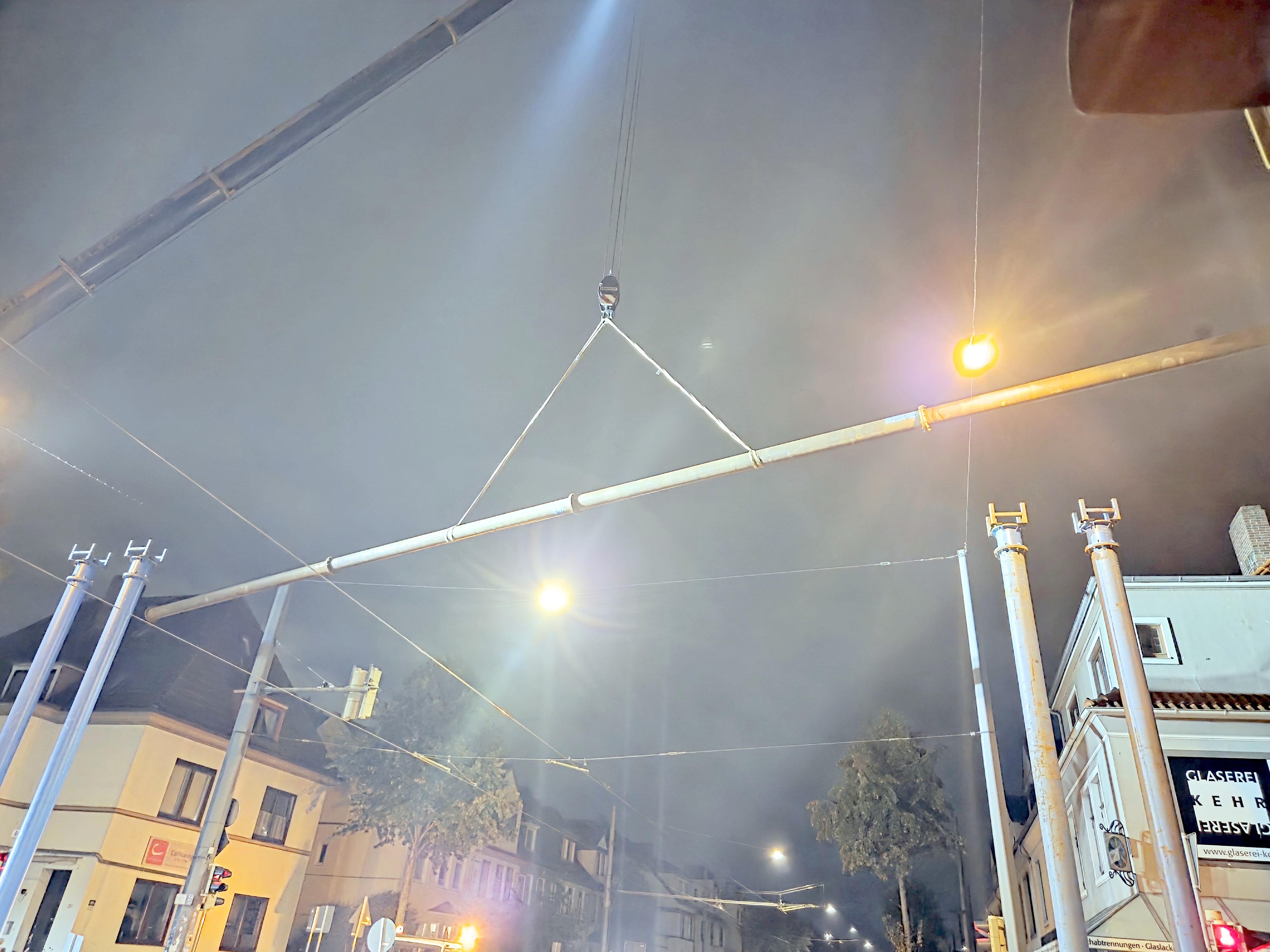
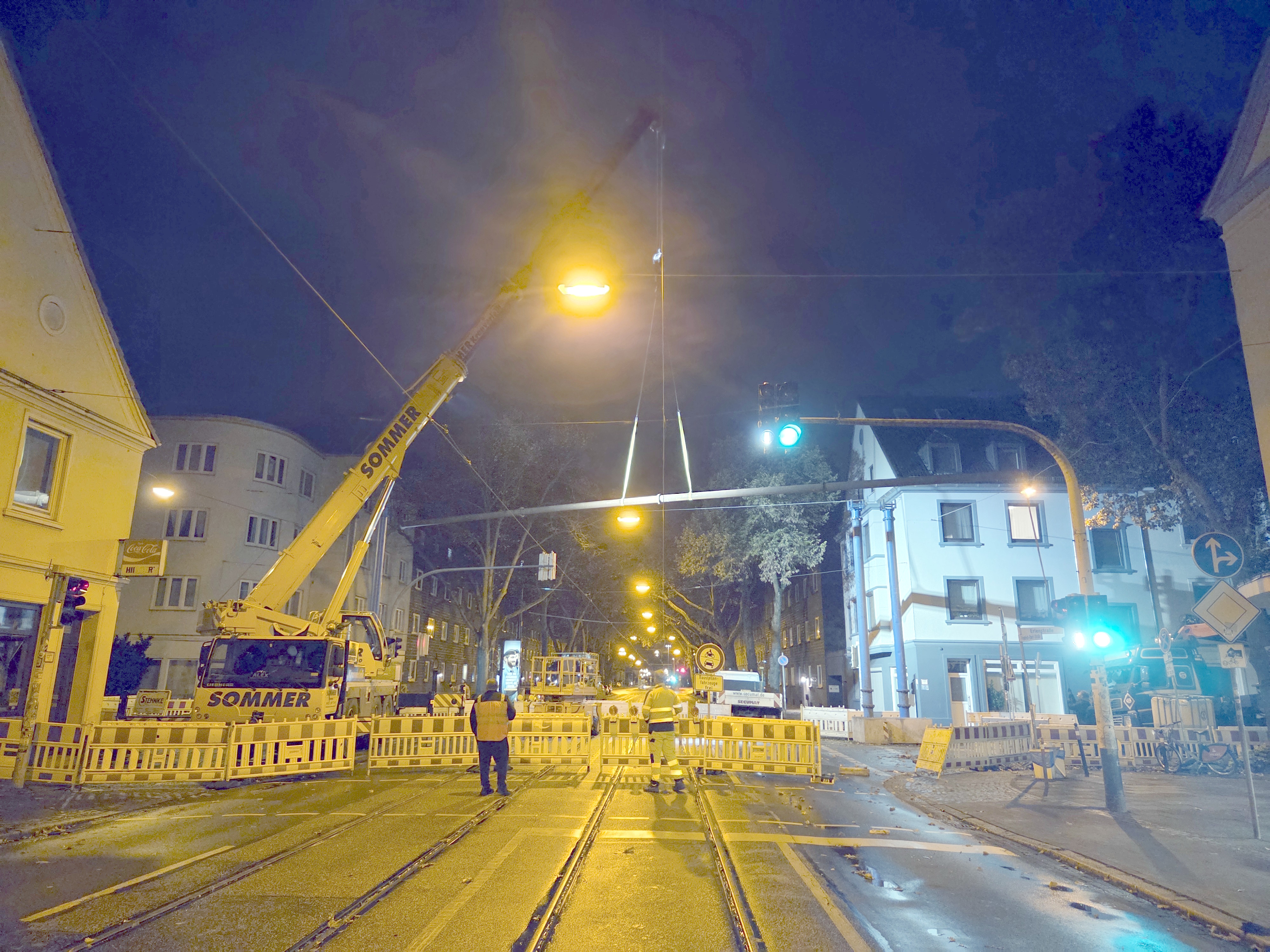
A large part of the line was laid underground. However, in areas with larger access roads as well as on side streets and two heavily frequented main traffic roads, the line had to be routed above ground on supports.
These constructions made it possible:
- the safe routing of the bypass line over the street area
- the uninterrupted flow of public transport and individual traffic
- the maintenance of fire brigade access routes
- the accessibility of adjacent streets and properties
Due to the high traffic volume, work on the support structures was carried out exclusively at night in order to keep disruption to traffic as low as possible.
Implementation in two construction phases
The overall project was realized in two construction phases.
In the first construction phase, the northern section of the sewer was rehabilitated. At the same time, the first drainage safeguard was installed and an initial group of connection pipes was rehabilitated. In addition, several manhole structures were repaired.
The second construction phase included the rehabilitation of the southern channel route. For this purpose, the bypass pipeline was implemented accordingly. In addition, further connection pipelines were rehabilitated, as well as the construction of an additional shaft. The work was concluded by final inspections and documentation of the rehabilitated pipeline sections.
Conclusion
Special challenges were the large-dimensioned insertion pits for the UV liner, the construction of launch pits for each house connection, as well as the complex drainage protection via elevated pipelines in the area of heavily frequented traffic routes with tram traffic.
Special thanks go to the entire team at the Hamburg branch for their commitment and the professional implementation of the measure.
More projects
-
Leipzig / Stuttgart
-
Mülheim: Sustainable large-profile rehabilitation with GeoKrete®
Freilassing
-
Bremen: Combined sewer in egg-profile renovated with UV liner
Blomberg / Hamburg / Hamburg Head Office
-
Gifhorn: Premiere in the railway environment of Deutsche Bahn
Blomberg
-
Bodenheim: Close-fit method secures drinking water transport pipeline
Alzey / Hörsching
-
Staßfurt: Sustainable coating of a brine tank
Nuremberg
-
Oberaudorf: Concrete rehabilitation of the Röthenbach stream culvert
Freilassing
-
Tegernsee Brewery: Trenchless manhole rehabilitation with polyurea
Freilassing / Nuremberg
-
Power plant pipelines: Tailor-made solutions
Hörsching
-
Germering: Sustainable pipe rehabilitation reduces energy demand in wastewater treatment plants
Freilassing
-
Herrenmühle Aulendorf: Pressure pipeline sustainably rehabilitated
Hörsching / Landsberg
-
Altrip: Trenchless rehabilitation secures flood protection at the pumping station
Alzey
-
Flensburg: Wound pipe technology in use beneath a former landfill
Hamburg / Leipzig
-
Wermelskirchen: Liner pipe technology shows strengths in combined rehabilitation
Alzey / Leipzig
-
RHV Mittleres Rodltal: Mouth profile rehabilitated with UV pipe liner
Hörsching
-
Neuss: Sewer rehabilitation in large dimensions DN 1200–1500
Blomberg
-
Freyburg relies on SPR-EX wound pipe technology
Hamburg / Leipzig